
Rocks & Red's & Route 66
August 2026
Downtown, the original Route 66 McKinley Bridge still carries traffic to and from the heart of St. Louis. And although John Steinbeck’s Mother Road changed names and pathways through the city toward Joplin and beyond, the old historic routes are marked.
And celebrated.
Driving through Rolla, gone are aromas from Route 66 icons: Toky’s BBQ, Chub & Jo’s fried chicken, Zeno’s steaks. But you can see a replica of Stonehenge, a tribute to one of the ancient world’s most dazzling feats of architecture. Situated on the campus of one of America’s top engineering schools, the University of Missouri Science and Technology, equidistant from Pine Street (the original Route 66 thru downtown) and I-44, Rolla’s laser-built Stonehenge marks the change of seasons with precision, except when a later-built high-rise dorm blocks the sun. Dang.
The impetus for choosing the name came from Springfield, Missouri.
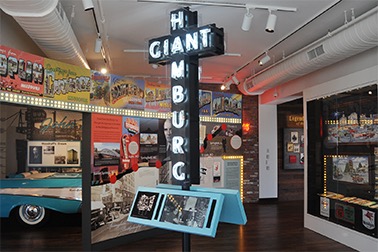
Rolling into Springfield for the night, I yearned for a burger from Red’s Giant Hamburg. Alas, Red’s is only a memory, gone for a dozen years now, but not forgotten. Red Chaney, the Charlie O. Finley of fast food, opened America’s very first drive-thru hamburger joint on old Route 66. It was also America’s first green restaurant, with a blue ceiling and a green floor, to imitate an outdoor picnic. Red looked a lot like Buddy Holly if Buddy had lived to be 70. And like Buddy, Red was an innovator. Long before fast food supersizers, the Redburger came in junior, giant, senior, jumbo and sooper.
He erected a wooden sign that was giant for its time, but not giant by today’s glorified interstate skypoking standards. It was in the shape of a two-word crossword puzzle. The two words: Giant (across) and Hamburg (down). The words intersected at the letter a. Because Red miscalculated the size of his sign, he had to leave the Hamburger’s last two letters off. Hence, the name Red’s Giant Hamburg.
The city razed the place after Red died in 1997, but the joint lives on in a local rockabilly song called “Reds” by the Morells “where the only thing French on the menu is fried.” Reds fell where it stood and left only a little grease spot behind.
Not to worry: Along old Route 66 I found a Steak ‘n’ Shake, but not just any old Steak ‘n’ Shake. This one is from 1962, said to be one of two surviving Steak ‘n’ Shakes with the ‘50s/’60s era design, so unique it’s on the National Register of Historic Places.
Missouri's Sloping Forehead
May 2026
That question is a reliable stumper in a trivia battle about Missouri. Sure, most folks can name the Mississippi and the Missouri. But identifying the other two river borders nearly always requires a lunge for the atlas.
One of those rivers is the St. Francis. On a map, it helps outline Missouri’s most distinguishable characteristic, the instep of Missouri’s fashionable Bootheel.
The fourth river? It flows across Missouri’s sloping forehead, along a county named for the commander of the Corps of Discovery. For about 25 miles, the Des Moines River borders the very northeast part of Clark County in the very northeast part of the state. Most folks just assume that when our ancestors carved out Missouri, they drew the state with a flat top, a straight line from the Mississippi across the Show-Me State’s noggin. Look closer. A chunk of Iowa extends 16 miles south of Missouri’s northern border. That southernmost Iowa appendage looks nothing like a fashionable “bootheel” so the corresponding dent in Missouri’s northeast corner goes mostly unnoticed.
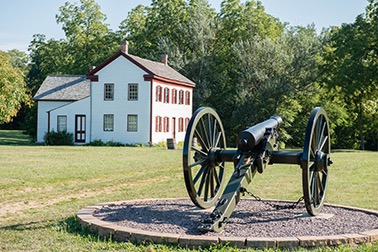
By the time my car delivered me to the Battle of Athens State Historic Site, I felt as tired as Mark Twain retreating (look it up). Indeed, in this northeasternmost part of Missouri, we’re closer to the state capitals of Iowa and Illinois than Missouri.
I can understand why people would want to settle here, and I promptly nestled into a secluded campsite myself and explored the Des Moines River Ravines Natural Area. The park enjoys a mile and a half of river frontage and enough hills and woods to get lost. The rolling hills and beautiful scenery stand as irrefutable proof that north Missouri is much more than flat farmland. Clark county boasts five separate conservation areas for hunting and fishing, plus the Great River National Wildlife Refuge along the Mississippi.
Driving south from Athens along the Des Moines River, I came upon the Illiniwek Village State Historic Site, the only known summer village once inhabited by the Indians of the Illiniwek Confederacy. The Illiniwek, or Illinois Indians, were prevalent when Europeans first came to Missouri. The village looks different today than it did back in 1673 when Marquette and Joliet visited the 8,000 villagers. The 300 lodges along a network of streets are reduced to an archaeological dig. Still, this village is the biggest and best-preserved of the Illiniwek culture.
My car doesn’t care that I’m the great-grandson of an Irish Catholic priest. Yet she obliged as I took a circuitous route from Illiniwek to the village of St. Patrick, not far from the Wyaconda River. I got a kick out of hanging out in the only place in the world where you can send a letter postmarked with the name of this legendary evangelist.
There’s a lot to discover, all tucked under this border river along Missouri’s sloping forehead.
Prine Time Road Dog
February 2026
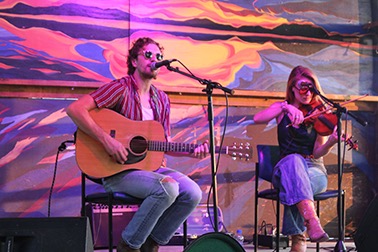
Forrest McCurren is a road dog. You hear it in his songs. The grit. The gears. The unexpected turns that produce a favorite mantra: You got to get lost to get found. His delivery is a pearl-snap shirt on a Saturday night, a Prinelike glimpse into sticky life, sycamore-sweet in the Texas heat, sparkling in his native Ozarks sun where the sacred Osage flows into the Missouri River.
He raises a beer to trailer park lovers with matching tats and waitresses wise beyond their barstools. His ballads salute good people who got bad grades in school, drunk on dreams, still trying to figure out if life is sour or sweet. Then he drives off in a van that looks like it might be your plumber.
Equally at home quoting Shakespeare and the Bible, McCurren’s pluck and dirt songwriting prompted Blake Shelton and Taylor Sheridan to stick him in the lineup to compete in the series, “The Road,” which airs on CBS.
That’s a feather in his cap. But his big break came a few years back when he met his muse.
I got lucky,” he says rhetorically, “in a life-changing course that shifted my focus from sports to music.”
He played soccer at Helias, a Catholic High School in Jefferson City, and ended up turning down a soccer scholarship at Saint Louis University, opting instead for William Jewell in Liberty where he might play more minutes.
The move was fortuitous for two reasons. At Jewell he met Margaret, and he picked up the guitar. Margaret, a bright eyed multi-talented musician who learned to read music before she learned to read words, grew up on her family’s suburban farms in St. Louis, then Boston.
Margaret encouraged his development. Her fiddle paired with Forrest’s voice and lyrics like a whiskey chaser. It wasn’t long before she had him playing more minutes in music than soccer, in venues that shouted Missouri character, like the Frank James Saloon in the postcard town of Parkville on the Missouri River.
Every road is a road home for somebody. McCurren’s latest album, “Small Prayers, Big Blessings” captures both road and home. “There’s a rowdiness that comes from the road and then there’s a thoughtfulness when we’re off the road, getting back home and putting in context how much you love your family.”
As you read this, Forrest may or may not have survived the competition on “The Road.” Regardless, he does his beloved Missouri proud.
I told him he has yet to make me cry. But the balladeer is young. The road is long. I am patient.
Visit ForrestMcCurren.com for more about the artist.
Painting the Town
November 2025
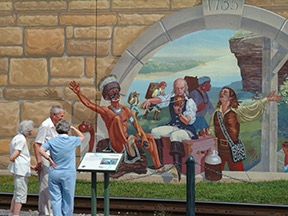
But in the past few years they have popped up like mushrooms. More than 10 dozen Missouri communities have livened up downtown spaces with murals, touting everything from the home of sliced bread to the baby chick capital of the world to the “neatest little town in Missouri.”
The earliest murals still speak to us from caves, where distant ancestors tried their hand at interior decorating. Now, wall art is in full bloom. From Hannibal to St. Joseph and points between, artists have mounted ladders and scaffolds, adorning willing walls with stunning portrayals of local history and culture.
A New York Times reporter visited Cape Girardeau a few years ago. The reporter wasn’t kind, complaining that the drab gray floodwall gave the city a medieval appearance. The wall separated the city from its lifeblood—the river—and discouraged visitors.
Cape Girardeau responded by launching a mural project on that floodwall, a bold artistic feat so stunning that historians will categorize Cape’s history as pre-mural and post-mural. The visuals are that good.
The people of Cape Girardeau embraced their history, their downtown and each other in smacking an artistic grand slam over a 12-foot-tall gray floodwall. And the murals have helped spawn a renaissance throughout downtown Cape Girardeau.
When the city announced a search for the perfect muralist to transform a barren wall, several world-class artists offered their services. Many had impressive credentials. They talked about their muralistic conquests across the globe. They proudly portrayed their portfolios.
Then a visionary young painter named Tom showed up, wearing a cheap suit and a red pork pie hat. Other artists attempted to win Cape’s favor by boasting of their prowess and finesse. Tom took a different approach.
“Who are your characters?” Tom asked. “What is your history?” He courted the town, and the town courted Tom, and they struck a relationship that sank deeper than a coat of paint.
Locals began to recognize him because he always wore that bright red pork pie hat. They spotted him everywhere. Rather than zipping into town for a quick interview and leaving in a whoosh of self-important urgency, Thomas Melvin stuck around. Like a fiddler on the roof, he perched and squatted in every possible spot to perceive the town and its rich fabric.
He talked to the townsfolk, and asked about things that were important to them and to their city. He dined with them at Port Cape Girardeau, a restaurant where, looking out a giant picture window, patrons and New York Times reporters saw an imposing gray floodwall. Tom saw a blank canvas...awaiting.
Now when you sit at a table in front of the big picture window at Port Cape Girardeau with a platter of ribs glazed three times and bathed in smoke, that picture window is bathed in tales of this river community.
Locked Out Again
August 2025
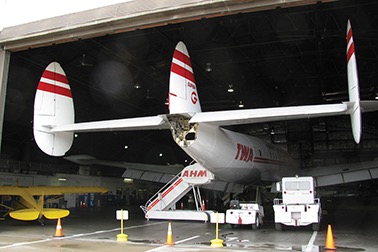
It wasn’t her fault. Connie was sweet and beautiful, her allure too hard to resist. I thought I could get away with it and stop for only a few minutes, if only to gaze upon her beautiful shape.
But my detour to her doorstep brought me deep despair. I paid dearly for my mistake.
Connie stays at Kansas City’s old municipal airport. She’s known more formally as a Lockheed Constellation, the airline workhorse of the 1950s. You’d instantly recognize the plane, with her curvy porpoise fuselage, three tail fins and four propellers—the poster plane for Howard Hughes’ TWA.
She sits in Hangar 9, a museum at the old airport, itself a relic, replaced by the larger, safer Kansas City International Airport. Tucked into a tight river bend beneath the watchful eyes of the Kansas City skyline, this airport museum gets overlooked by just about everybody, one of Kansas City’s best-kept secrets.
On the day we visited the old airport, foul weather had grounded flights. Forecasters predicted tornadoes. So Erifnus, my car, delivered me through the howling wind and rain into the parking lot.
As I climbed out and locked her doors, I realized I’d left the keys in her ignition. I stood, numb, frozen—not from the wind and rain that pelted me, but from my own stupidity.
Erifnus Caitnop doesn’t deserve such rude neglect. She’s performed nearly flawlessly as my Trigger, my Lassie and my Old Faithful all rolled into 140 horsepower. She is my one constant companion along this journey across every mile of every road on Missouri’s highway map, my trusty steed for 15 years and nearly 300,000 miles.
But on this day, she sat protecting my keys from the wind and the rain.
And me.
I must confess that this is not the first time I’ve locked the keys in this car. In fact, I’ve probably tied a world record: performing this stupid feat twice in one day. That memory is painful. At the end of that horrible day I promised Erifnus I’d never again treat her with such neglect.
But over the years, as with most partnerships, there were stressful moments. Most were caused by driver error. Spinouts. Warning tickets. Getting stuck in mud. Sliding sideways under downed power lines. Stuff like that.
And now this.
I regained my composure and entered the museum hangar, confessing my stupidity to the friendly folks inside. They were extremely helpful, being pilots and mechanics and classic airplane lovers.
But try as we did, we couldn’t make a coat hanger unlock my car.
So after a tour of the museum and a walk down the aisle of that classic old aircraft with its three tail fins and four engines and porpoise-shaped fuselage—and $90 for a locksmith—I thanked my hosts, said farewell to Connie, tucked my tail fin in the driver’s seat, and drove home.